



Recent Posts
Contact Us
Author : Marketing Team | Follow us on LinkedIn:
2 Dec, 2025
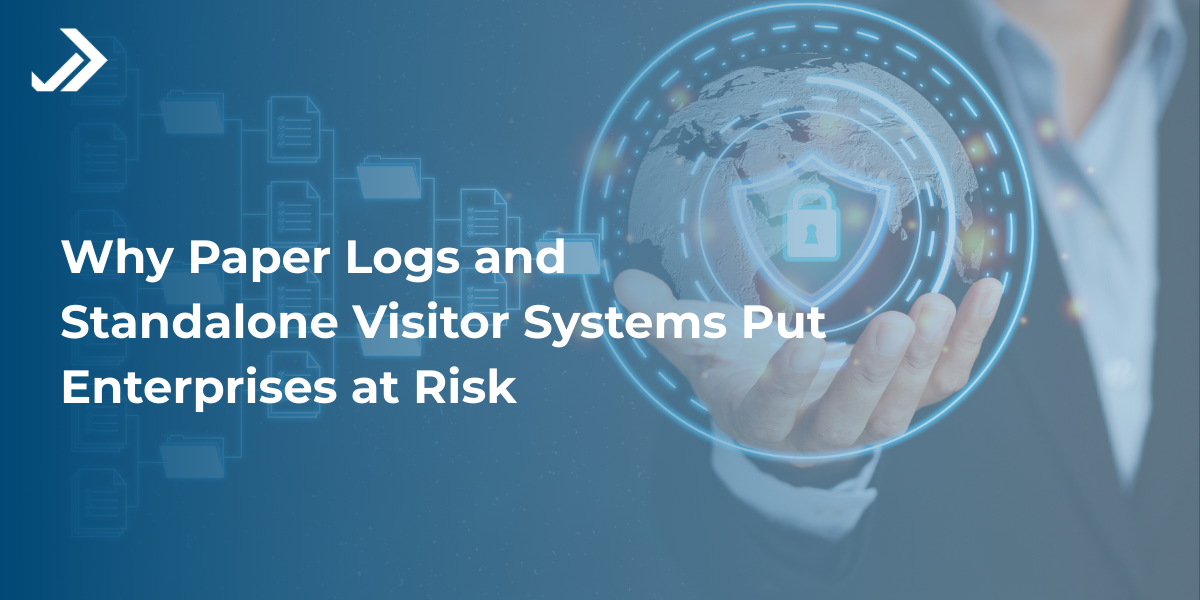
Why Paper Logs and Standalone Visitor Systems Put Enterprises at Risk
Table of Contents
Still using paper sign-in sheets? They appear simple, but they create blind spots, such as illegible entries, missing pages, and unreliable headcounts during evacuations. Safety guidance expects you to account for visitors in emergencies, which the paper lists handled poorly. Privacy is another issue: open logbooks expose personal data, conflicting with GDPR expectations. A modern visitor management solution keeps records time-stamped, access-controlled, and auditable.
In this blog, you’ll get a clear, no-nonsense view of what matters most: the real risks of paper and standalone tools (security, compliance, privacy, and emergency response), how a connected visitor management solution delivers real-time visibility and audit-ready records, and why this shift creates strategic value for HR and Admin.
The Illusion of Security: Why Paper Logs Still Survive
Paper sign-in sheets are considered safe because they’re visible, familiar, and inexpensive. That’s the illusion. A ledger creates the impression of control, but it doesn’t verify identity, prevent tailgating, or give you a real-time list of who is inside. Handwriting is unclear, pages go missing, and there’s no reliable audit trail. When HR or Security needs accurate data, the paper record immediately shows its limits.
Another reason paper survives is the belief that it’s “good enough for compliance.” In reality, it exposes personal data on an open desk, making retention, consent, and access control difficult to manage. A visitor management system handles these basics by time-stamping every check-in, enforcing policies, and restricting access to sensitive information.
Operationally, paper is slow. Front desks spend time chasing hosts, printing ad-hoc badges, and reconciling lists across buildings. A connected visitor management solution streamlines all of this with pre-registration, QR check-ins, photo capture, and instant host notifications so arrivals move quickly and records stay accurate.
In an emergency, the gap is most significant. Paper can’t produce a live muster list on demand. A modern visitor management system can. If the goal is absolute control, not the appearance of it, replacing paper with a scalable visitor management solution is the practical next step.
The Risks Enterprises Overlook with Legacy Visitor Systems
Legacy visitor setups look “good enough,” but they hide risks that only show up when you need reliable data, fast coordination, or clean audits. Here’s what most enterprises overlook—and why moving to a modern visitor management system matters.
1) Security blind spots: Paper logs or desktop-only tools don’t verify identity, check watchlists, or alert hosts in real time. That means tailgating, unreadable names, and untracked movements. A connected visitor management solution adds photo capture, pre-registration, and instant notifications so the lobby becomes a controlled entry point, not just a queue.
2) Weak audit readiness: Regulators and customers expect accurate, time-stamped records showing who entered, when, why, and who approved it. Legacy tools scatter data across notebooks and PCs. A digital visitor management solution centralizes logs across locations and makes them searchable in seconds.
3) Privacy exposure: Open logbooks and shared desktops casually reveal names, companies, and phone numbers. A modern visitor management system utilizes consent flows, role-based access controls, and retention policies to ensure that visitor data is appropriately handled and access is traceable.
4) Operational drag: Front desks lose time calling hosts, retyping details, and reprinting badges. Disconnected systems don’t scale across multiple sites or shifts. With a unified visitor management solution, pre-registration, QR check-ins, and automated host alerts reduce queues, allowing staff to focus on providing service.
5) Poor emergency readiness: In evacuations or drills, legacy setups can’t produce a live, mobile muster list. A digital visitor management solution provides real-time headcounts on any device, enabling teams to confirm accountability quickly.
6) Inconsistent brand experience: A clunky check-in creates friction for candidates, clients, and vendors. A modern visitor management system delivers a smooth, professional first impression.
Legacy tools create a comfortable illusion, not absolute control. Standardize on a connected, enterprise-grade visitor management solution to reduce risk, protect privacy, speed operations, and strengthen trust.
Why Standalone Visitor Systems Are Just as Dangerous
Standalone visitor tools, such as desktop apps, badge printers, and neat interfaces, may appear modern, but they often carry the same risks as paper, just in digital form. Without integration, they become isolated islands of data. That means no live visibility across floors or sites, no automatic alerts to hosts, and no way to reconcile visitor activity with access control or HR systems. A connected visitor management system solves these gaps; a standalone tool usually doesn’t.
Key problems with standalone setups:
- Limited visibility: Data sits on a single workstation. If the PC is busy, down, or unattended, check-ins stall and security loses oversight. A cloud-based digital visitor management solution gives real-time, multi-location dashboards on any device.
- No integration: Standalone tools typically don’t connect to access control, HRMS, or compliance platforms. You’re stuck exporting CSVs and stitching spreadsheets. A proper visitor management solution syncs pre-registration, check-ins, badges, and approvals with your existing stack.
- Weak audit readiness: When Legal or customers ask, you need clean, time-stamped logs. Local databases and ad-hoc exports slow you down. A modern visitor management system centralizes records, making audits and investigations straightforward.
- Privacy risks: Shared logins, local backups, and uncontrolled exports put personal data at risk. A compliant digital visitor management solution ensures enforcement of consent, role-based access, and retention policies.
- Emergency response gaps: During an evacuation, you need to have live muster lists on mobile devices with status information organized by floor, host, and visitor type. A single-PC setup can’t deliver that. A connected visitor management solution can.
- Scalability limits: As you add sites, vendors, or contractors, a standalone tool becomes a bottleneck. A cloud-first visitor management system scales effortlessly and consistently enforces policies.
Replacing paper with a desktop app is not the same as modernizing. To reduce risk, improve compliance, and enhance first impressions, adopt an integrated digital visitor management solution that provides real-time visibility, robust privacy controls, and enterprise-grade reporting.
The Case for a Digital Visitor Management Solution
A modern digital visitor management solution does more than replace a paper log; it upgrades the entire front-door process to be faster, safer, and easier to manage. If your goal is to maintain reliable records, ensure smooth check-ins, and achieve confident compliance, a connected visitor management system is the practical solution.
Real-time visibility: Know exactly who is on-site, across locations, at any moment. Live dashboards display visitor status (arrived, pending, checked out), allowing HR and Admin to act quickly without needing to call the front desk.
Frictionless check-ins: Pre-registration, QR codes, photo capture, and instant host notifications streamline the process, reducing queues and errors. Guests move from the lobby to the meeting room without delay, and your team spends less time on manual data entry.
Compliance and audits: Time-stamped logs, consent capture, and document workflows (e.g., NDAs, safety acknowledgments) come built in. When auditors or customers ask for records, a visitor management solution retrieves them in seconds—no spreadsheets, no searching through email.
Privacy by design: Role-based access, retention rules, and secure storage protect personal data and reduce risk. Unlike open logbooks or shared desktops, a digital visitor management solution maintains controlled and traceable information.
Emergency readiness: During evacuations or drills, mobile muster lists show who is still inside, by floor, and by host. This turns a stressful moment into a coordinated process and provides clear post-event reports.
Integration that saves time: Connect check-ins to access control for temporary badges, to HRMS for contractor oversight, and to IT for network guest access. A connected visitor management system eliminates duplicate work and aligns visitor activity with established policies.
Analytics and planning: See peak arrival times, vendor frequency, and service bottlenecks. These insights help you staff the lobby better, negotiate vendor SLAs, and improve the visitor experience over time.
Scalability and consistency: As you add sites or contractors, policies remain consistent. Centralized configuration ensures the same high standard at every location—no local workarounds, no uneven procedures.
Brand experience: First impressions start at the lobby. Professional badges, clear directions, and fast check-ins reflect well on your organization and set the tone for the entire visit.
Total cost and ROI: Fewer manual tasks, fewer errors, faster audits, and shorter queues translate to real savings. The upgrade is not just about software but about reclaiming time, reducing risk, and raising operational quality.
An integrated, enterprise-grade visitor management solution replaces fragmented tools with one reliable, secure, and scalable process. It’s the simplest way to enhance safety, compliance, and the overall experience.
Strategic Value for HR and Admin Leaders
A modern visitor management system gives HR and Admin something they rarely have at the front desk: control with less effort. Pre-registration, QR check-ins, and instant host alerts reduce queues and interruptions, allowing teams to spend more time on people and less on paperwork. Live dashboards display exactly who is on-site across locations, enabling you to manage contractors, vendors, and interview candidates efficiently without relying on phone calls or manual lists.
Compliance becomes simpler. A connected visitor management solution automatically time-stamps visits, captures consent and NDAs, and keeps records searchable for audits. Privacy improves as well—role-based access and retention rules protect personal data, preventing the exposure that comes with paper logs or shared spreadsheets.
Safety is stronger. During evacuations or drills, a digital visitor management solution provides real-time muster lists on any device, transforming a stressful task into a precise and repeatable process. Integration eliminates duplicated work: temporary badges can sync with access control, contractor hours can be seamlessly integrated into HRMS, and guest Wi-Fi can be provisioned according to IT policies.
You also gain insights. Analytics reveal peak hours, recurring visitors, and service bottlenecks, guiding staffing and vendor SLAs. Finally, the lobby experience, with professional badges, faster check-ins, and clear directions, sets a confident and consistent tone for your brand.
Conclusion
Paper logs and disconnected tools might feel familiar, but they don’t give you absolute control when it counts. A modern visitor process should be simple for guests, straightforward for hosts, and reliable for HR and Admin. Moving to an integrated visitor system delivers that: faster check-ins, accurate records, stronger privacy, and real-time visibility across locations. It also streamlines audits and frees your team from manual chasing and guesswork. If your front desk still relies on paper or standalone apps, this is the easiest place to upgrade and see immediate impact on safety, compliance, and first impressions.


