



Recent Posts
Contact Us
Author : Marketing Team | Follow us on LinkedIn:
8 Jul, 2026
Access Control in Pharmaceutical Manufacturing: From Door Security to Regulatory Compliance
Table of Contents
Introduction – Why Access Control Has Become a Governance Issue
Pharmaceutical manufacturing has always been built on one fundamental principle—control. Every raw material is traceable, every manufacturing process is validated, every environmental condition is monitored, and every quality-critical activity is documented. These controls ensure that medicines reaching patients are safe, effective, and manufactured consistently.
Increasingly, the same level of discipline is expected in the movement of people.
Traditionally, access control was viewed as a physical security function responsible for protecting facilities from unauthorized entry. In today’s pharmaceutical environment, however, its role has expanded significantly. Regulators, auditors, and quality teams now expect organizations to demonstrate that only authorized personnel can access regulated areas, that permissions are aligned with roles and responsibilities, and that every movement can be accurately traced when required.
This shift has transformed access control from a facilities management tool into an integral part of enterprise governance.
Consider a typical audit scenario. An investigator may ask who entered a sterile manufacturing suite during a specific batch, whether a contractor’s authorization was valid during maintenance, or how quickly access privileges were revoked after an employee changed roles. These questions extend far beyond physical security—they relate directly to quality assurance, operational discipline, and data integrity.
Modern pharmaceutical facilities are also becoming increasingly digital. Electronic Batch Records (EBR), Manufacturing Execution Systems (MES), Laboratory Information Management Systems (LIMS), ERP platforms, and computerized quality systems have become integral to manufacturing operations. As digital transformation accelerates, physical identity must evolve alongside these systems. Organizations need confidence that every electronic record and every physical movement can be attributed to the right individual at the right time.
Access control is therefore no longer about securing doors alone. It has become part of a broader identity ecosystem that connects HR, Quality Assurance, IT, Security, Operations, and Compliance.
Organizations that recognise this shift are no longer investing in standalone access control systems. They are building enterprise identity platforms that strengthen governance, improve inspection readiness, simplify workforce management, and provide a trusted foundation for regulatory compliance.
Regulatory Expectations: 21 CFR Part 11, Schedule M & ALCOA+
One of the biggest misconceptions about pharmaceutical regulations is that they prescribe specific technologies for access control. They do not. Instead, they establish principles that organizations must demonstrate through effective processes and systems.
Whether the reference is India’s revised Schedule M, US FDA’s 21 CFR Part 11, WHO-GMP guidelines or international data integrity expectations, the underlying objective remains remarkably consistent: organizations must maintain controlled environments, restrict access to authorized personnel, and preserve reliable evidence of every regulated activity.
This makes identity management an important contributor to compliance.
21 CFR Part 11 – Trusted Records Begin with Trusted Identity
21 CFR Part 11 primarily governs electronic records and electronic signatures, ensuring that electronic information is trustworthy, reliable, and equivalent to paper records.
However, every electronic record ultimately depends upon one critical element—identity.
If an operator performs a manufacturing activity, approves a batch record, or accesses a validated computerized system, the organization must demonstrate that the action was performed by an authorized individual. Physical access to production areas and digital access to manufacturing systems are therefore closely connected.
Reliable identity verification strengthens confidence in electronic records by ensuring that activities can always be traced back to the correct individual.
Revised Schedule M – Controlling People as Well as Processes
India’s revised Schedule M places renewed emphasis on quality systems, contamination control, computerized systems, documentation, and Good Manufacturing Practices.
An important theme running throughout these requirements is the concept of maintaining controlled environments.
This extends beyond equipment qualification and environmental monitoring. It also applies to personnel movement.
Employees should only access areas relevant to their responsibilities. Engineering contractors should receive temporary permissions limited to approved work areas. Visitors should remain within designated zones under appropriate supervision.
By digitally enforcing these controls, organizations reduce the possibility of unauthorized movement while creating verifiable evidence that controlled environments remain protected.
ALCOA+ and Data Integrity
Data integrity has become one of the defining themes of pharmaceutical compliance.
The ALCOA+ principles require information to be:
- Attributable
- Legible
- Contemporaneous
- Original
- Accurate
while also remaining Complete, Consistent, Enduring, and Available.
Although these principles are often associated with manufacturing and laboratory records, they apply equally to access records.
Every access event should clearly establish:
- Who entered?
- Which area was accessed?
- When did the event occur?
- Was the individual authorized?
More importantly, these records should remain protected from unauthorized modification, securely retained, and immediately retrievable during inspections.
The objective is not merely to maintain logs—it is to maintain credible evidence.
Inspection Readiness Rather Than Compliance
Leading pharmaceutical companies increasingly view compliance as a continuous state rather than an activity undertaken immediately before an inspection.
During an audit, organizations should be able to answer questions quickly and confidently:
- Who entered the sterile suite yesterday?
- Which contractor accessed the utility area during maintenance?
- When were access rights revoked for a resigned employee?
- Who entered the batch documentation room during a specific investigation?
If this information requires manual reconciliation across multiple systems, spreadsheets, or paper registers, the organization introduces unnecessary operational risk.
Inspection-ready organizations instead rely on integrated identity platforms that provide complete, accurate, and searchable audit trails whenever required.
The discussion therefore shifts from “Do we have an access control system?” to “Can our access control system demonstrate operational control and regulatory compliance?”
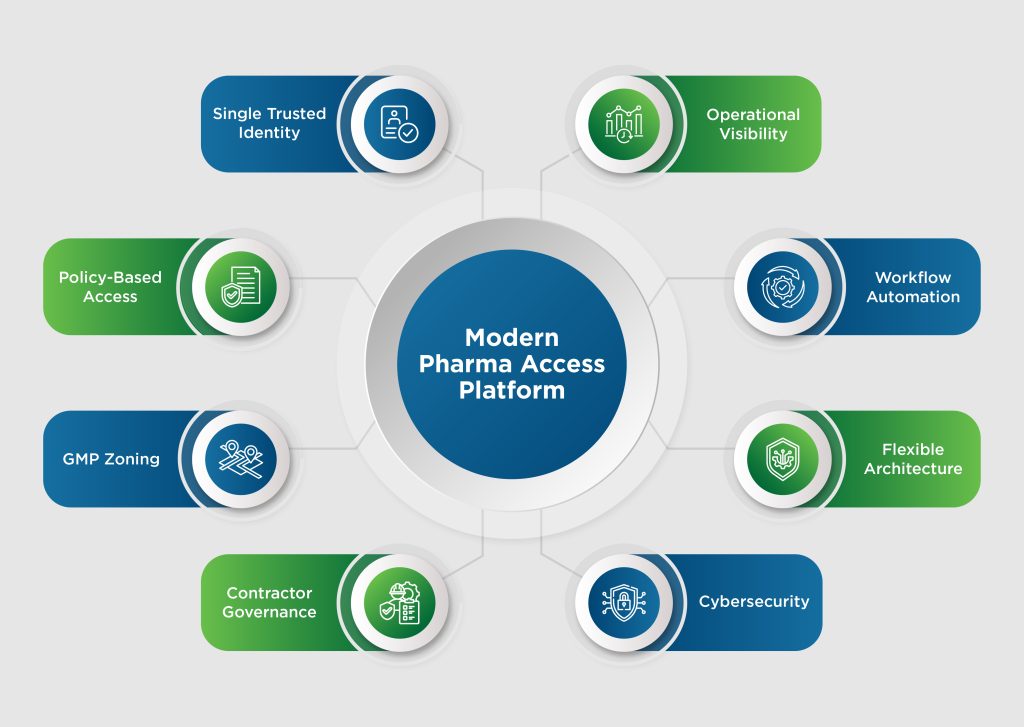
Characteristics of a Modern Pharmaceutical Access Control Platform
Meeting regulatory expectations requires far more than installing biometric readers at entry points.
An enterprise-grade pharmaceutical access control platform should become part of the organization’s operational infrastructure—supporting compliance, workforce governance, cybersecurity, and long-term business continuity.
The following characteristics distinguish modern enterprise platforms from conventional access control deployments.
A Single Trusted Identity Across the Enterprise
Many organizations continue to maintain separate identity databases for HR, attendance, visitor management, contractor administration, and access control.
Over time, these disconnected systems create inconsistencies.
An employee changes departments, but access permissions remain unchanged.
A contractor completes a project, but credentials remain active.
Visitor information is recorded separately from access logs.
Modern enterprise platforms eliminate these inconsistencies by establishing a single trusted identity across all workforce-related applications.
Every employee, contractor, and visitor is managed through one authoritative identity that supports attendance, physical access, workforce governance, and compliance reporting.
This not only simplifies administration but also strengthens audit readiness by ensuring consistency across every system.
Access Rights Should Reflect Responsibilities
Access permissions should no longer depend on manual administration.
Instead, they should follow organizational policies.
An employee’s department, designation, location, shift, training status, and employment lifecycle should collectively determine what areas can be accessed.
When HR updates an employee’s role, corresponding access permissions should automatically reflect those changes.
Similarly, when employment ends or contractor engagements expire, physical access should be revoked immediately across all facilities.
This policy-driven approach significantly reduces administrative effort while minimizing the risks associated with outdated permissions.
Digital Enforcement of GMP Zoning
Every pharmaceutical manufacturing facility operates through controlled zones.
Production suites, quality laboratories, warehouses, engineering areas, utilities, documentation rooms, and data centres each require different levels of authorization.
Traditionally, organizations relied heavily on procedures and manual supervision to enforce these boundaries.
Modern access control systems provide digital enforcement.
Only authorized personnel can enter designated areas.
Permissions can vary by shift, department, project, qualification status, or maintenance schedules.
Temporary contractors receive time-bound access, while visitors remain restricted to approved zones.
By replacing manual controls with automated enforcement, organizations improve operational discipline while reducing opportunities for human error.
Contractor Governance as an Extension of Workforce Governance
One area often overlooked in pharmaceutical manufacturing is contractor management.
Engineering vendors, validation specialists, equipment suppliers, maintenance personnel, housekeeping teams, and construction contractors frequently require access to regulated facilities.
Unlike permanent employees, however, their engagement is temporary and often project-specific.
An enterprise platform should manage contractors with the same rigor as permanent employees while recognizing the temporary nature of their work.
Access permissions should activate automatically on approved start dates, expire at project completion, and remain restricted to approved areas and working hours.
Structured contractor governance not only improves compliance but also strengthens overall operational visibility.
Operational Visibility Beyond Security
Modern pharmaceutical organizations expect far more from access control than monitoring entry and exit events.
They require real-time visibility into workforce movement across the facility.
Questions such as these have operational as well as compliance significance:
- Which contractors are currently inside the plant?
- Which production areas remain occupied after operational hours?
- Which access attempts were denied due to expired permissions?
- How many personnel are present in a particular manufacturing block during an emergency?
When identity information is available in real time, organizations can improve workforce planning, emergency preparedness, contractor oversight, and operational decision-making while simultaneously strengthening compliance.
Access control therefore evolves from a security application into an enterprise operational platform.
Technology Should Simplify Compliance
One of the hidden costs of fragmented systems is the manual effort required to maintain them.
Access requests are managed through emails. Contractor permissions are updated manually. Reports are exported from multiple systems and consolidated using spreadsheets. Role changes require intervention across several applications.
This approach consumes administrative effort while increasing the likelihood of human error.
Modern enterprise platforms automate these workflows.
Employee onboarding, department transfers, contractor expiry, visitor approvals, credential revocation, and compliance reporting become standardized processes rather than manual activities.
Automation not only improves efficiency but also ensures that organizational policies are applied consistently across the enterprise.
Technology Should Adapt to Business Processes
Every pharmaceutical organization operates differently.
A sterile injectable manufacturing facility has different zoning requirements from an API plant. A research laboratory functions differently from a commercial manufacturing site. Multi-location enterprises require governance models that differ from single-site facilities.
An enterprise access control platform should accommodate these operational differences without requiring organizations to redesign established quality or business processes.
The objective is not to make pharmaceutical operations conform to software.
It is to configure technology around regulatory requirements, manufacturing practices, workforce policies, and organizational objectives.
This flexibility ultimately distinguishes an enterprise platform from a collection of independent access control devices.
Cybersecurity, OEM Architecture & the Make-in-India Advantage
As pharmaceutical organizations continue their digital transformation journey, the convergence of physical security and cybersecurity has become increasingly important.
Access control systems are no longer isolated from the enterprise network. Biometric readers, intelligent controllers, management software, visitor systems, HR applications, and building management platforms continuously exchange sensitive identity information.
This makes access control part of an organization’s cybersecurity posture.
Consequently, evaluating an access control platform solely on authentication speed or hardware specifications is no longer sufficient. Organizations must also consider how securely the entire ecosystem has been designed.
Identity data should remain protected throughout its lifecycle—whether stored in databases, transmitted between devices, or exchanged with enterprise applications. Encryption of data at rest and in transit, secure communication protocols, role-based administration, and regular vulnerability assessments have become essential elements of enterprise-grade access control.
Cybersecurity, therefore, should never be viewed as an additional feature.
It should be built into the architecture itself.
Why System Architecture Matters
Large enterprises often inherit access control infrastructure that has evolved over many years.
Hardware from one manufacturer, controllers from another, software from a third vendor, and custom integrations developed independently may satisfy immediate operational needs but often create long-term challenges.
Software upgrades may affect hardware compatibility. Security updates may depend on multiple vendors. Troubleshooting frequently requires coordination across different support organizations.
As facilities expand and compliance expectations become more demanding, these fragmented environments become increasingly difficult to manage.
An integrated architecture eliminates much of this complexity by ensuring that hardware, firmware, controllers, and enterprise software are designed to function as one coordinated ecosystem.
The result is greater reliability, simplified lifecycle management, predictable upgrades, and stronger cybersecurity.
The Value of a Make-in-India OEM
For organizations operating in regulated industries, selecting a technology partner is about much more than product features.
Long-term engineering support, product evolution, supply chain resilience, regulatory responsiveness, and lifecycle continuity are equally important.
As a Make-in-India Original Equipment Manufacturer (OEM), Spectra designs and develops both its purpose-built biometric hardware and enterprise software entirely in-house. This enables every component—from biometric devices and intelligent controllers to the management platform—to be engineered together rather than integrated after development.
The difference is significant.
Instead of assembling products from multiple sources, organizations benefit from a unified ecosystem with consistent security policies, seamless interoperability, simplified maintenance, and a single point of accountability throughout the solution lifecycle.
This philosophy extends beyond technology.
It reflects a commitment to building indigenous, enterprise-grade solutions that address the evolving needs of Indian industry while meeting global expectations for quality, security, and reliability.
Conclusion: Building Trust Through Enterprise Identity
Pharmaceutical manufacturing has always depended upon discipline.
Processes are validated. Equipment is qualified. Environmental conditions are monitored. Documentation is meticulously maintained.
Identity deserves the same level of control.
As regulatory expectations continue to evolve, access control can no longer be viewed simply as a mechanism for securing doors. It has become an important component of quality systems, workforce governance, cybersecurity, and regulatory compliance.
Organizations that continue to rely on fragmented systems may find themselves spending valuable time reconciling information during inspections and managing unnecessary operational complexity.
Those that invest in integrated identity platforms gain much more than improved security. They establish a trusted foundation for workforce management, operational efficiency, inspection readiness, and long-term governance.
At Spectra, this philosophy has shaped our approach for more than 25 years.
Our Make-in-India ecosystem combines purpose-built biometric hardware with our enterprise platform, iApp, creating a unified solution for Attendance Management, Physical Access Control, Visitor Management, Contractual Workforce Compliance, Canteen Management, and Workforce Governance. Because the hardware and software are engineered together—not bolted together—organizations benefit from a solution that delivers consistent performance, enterprise-grade cybersecurity, and simplified lifecycle management.
For pharmaceutical manufacturers, the real value of access control lies not in opening doors faster, but in creating trusted identity across the enterprise.
When every employee, contractor, and visitor is governed through a secure, unified platform, organizations are better equipped to meet regulatory expectations, protect operational integrity, and build confidence with auditors, regulators, customers, and ultimately, the patients they serve.
access control solutionAccess Control SystemAccess control system for doorsaccess control system for pharmaceutical industry


