


Recent Posts
Contact Us
Author : Marketing Team | Follow us on LinkedIn:
19 Jun, 2026
How Enterprises Can Manage Access Control Across Multiple Facilities from One Dashboard
Table of Contents
Picture this: a manufacturing company with a head office in Ahmedabad, a plant in Pune, a warehouse in Bhiwandi, and a regional office in Delhi. Four locations, four separate security setups, four different teams managing access logs, and zero consolidated picture of who has access to what.
When there’s a security incident, no one has the full story. When an employee is terminated, chances are their credentials are revoked at two out of four locations. When an auditor asks for access logs, someone is pulling records from different systems and praying the formats match.
This isn’t a hypothetical scenario; it’s the everyday reality for a large percentage of mid-to-large Indian enterprises still running location-specific, siloed access control setups. And it’s a problem that compounds with every new facility added.
The good news: this entire problem is solvable from a single dashboard.
Why Multi-Location Access Control Breaks Down
Enterprises don’t start with complexity; it accumulates. A company typically starts with one office, installs an access control system that works well, and then grows. Each new facility gets its own setup, often from a different vendor or a different integration team. Before long, the organization is maintaining multiple unconnected systems.
The operational gaps this creates are significant:
Employee data has to be enrolled separately at each site. A new joinee starting at the head office still can’t access the regional warehouse without a manual request and a separate enrollment there.
Access revocations are delayed or missed. When someone resigns or is terminated, their credentials may be deactivated at the primary site but remain active across other locations for days.
There’s no unified audit trail. If a compliance audit requires access logs from all sites for a given date range, administrators are manually exporting reports from four different systems and reconciling them.
Security teams can’t respond quickly. A suspicious access attempt at one site doesn’t automatically trigger visibility at the central security team unless someone manually flags it.
Contractor and visitor access is even more fragmented. Temporary access for a contractor working across sites means multiple approvals, multiple enrollments, and no central expiry tracking.
None of this is about negligence. It’s structural, because the systems were never designed to talk to each other.
What a Centralized Access Control Dashboard Actually Does
A centralized access control system brings all facilities under one management interface. Instead of logging into separate consoles for each location, administrators manage everything, including enrollments, permissions, alerts, reports, and door-level configurations, from one screen.
Here’s what that looks like in practice:
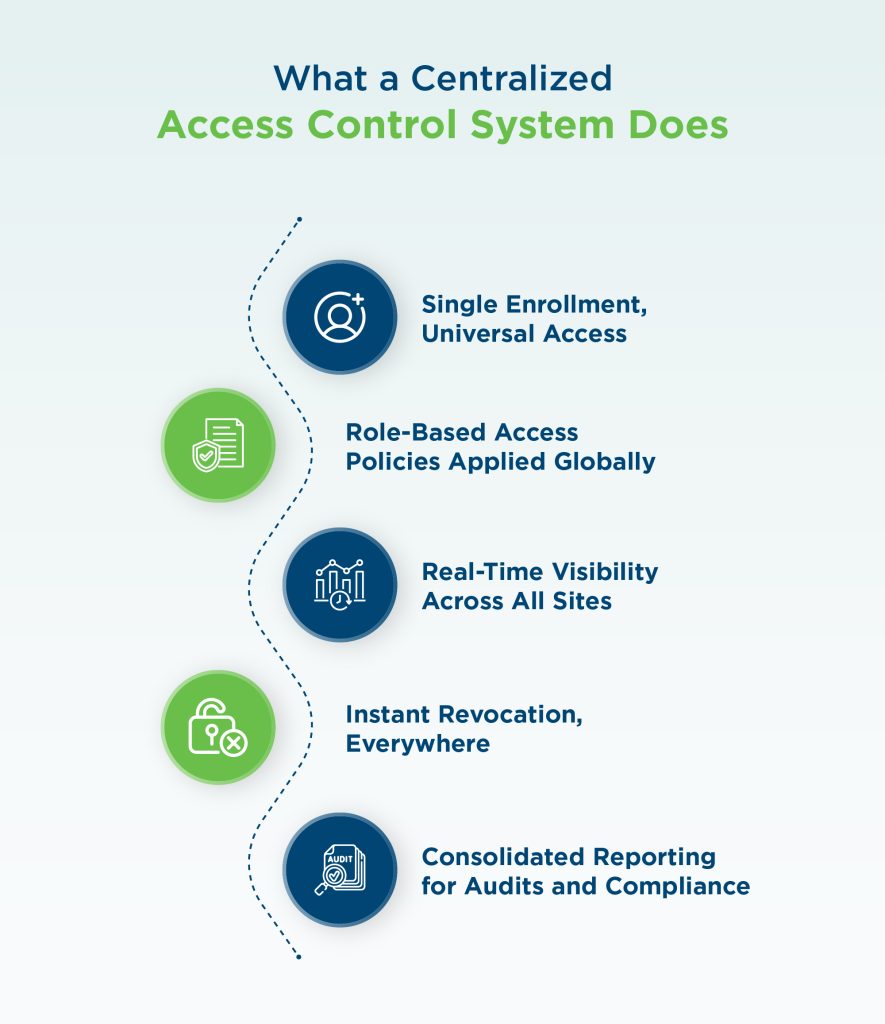
1. Single Enrollment, Universal Access
An employee enrolled once in the central system gets credentials that are valid across all authorized locations instantly. No re-enrollment at each site. No waiting for the local security team to set it up. The biometric or card data syncs to every relevant device based on the access permissions assigned to that employee’s role.
For companies hiring at scale or managing frequent inter-site transfers, this alone cuts significant administrative overhead.
2. Role-Based Access Policies Applied Globally
Access rights shouldn’t be an afterthought; they should follow the employee’s role and department. A centralized system lets you define what the ‘Purchase Manager’ profile can and cannot access: which doors at which locations during which hours. When someone moves roles, one policy update flows across all sites.
This is especially useful for enterprises managing contract labor across multiple plants. Contractor profiles can be configured with time-bound permissions, active for the duration of a project, automatically expiring on the exit date without any manual follow-up.
3. Real-Time Visibility Across All Sites
Centralized dashboards give security and facility managers a live view of access activity across every location simultaneously. Unauthorized access attempts, door-held-open alerts, or tailgating events at any facility surface immediately to the same central monitoring interface.
For large enterprises where the security head sits at the corporate office but needs oversight of remote plants, this changes the nature of security management entirely. Response time improves. Blind spots disappear.
4. Instant Revocation, Everywhere
When an employee leaves the organization, their access is terminated in one action, and that termination propagates to every device, at every facility, immediately. There are no gaps, no delayed syncs, no oversight because someone forgot to notify the branch security team.
For industries with strict data security requirements, like pharma, BFSI, and R&D, this isn’t just operationally convenient. It’s a compliance necessity.
5. Consolidated Reporting for Audits and Compliance
Audit season is stressful enough without having to stitch together access logs from six systems. A centralized setup lets administrators pull unified reports, filtered by date, location, employee, department, or door, within minutes.
For enterprises operating under regulatory frameworks like ISO 27001, or those subject to labor law compliance for contract workers, consolidated and tamper-proof access records are non-negotiable.
The Visitor and Contractor Layer
Managing full-time employees is only part of the challenge. In most enterprise environments, a significant portion of daily movement involves visitors, vendors, auditors, and contract workers, people who need controlled, temporary, and sometimes cross-location access.
An integrated visitor management system, when connected to the central access control dashboard, makes this manageable. A vendor pre-registered for a two-day inspection at a manufacturing unit gets a time-bound credential automatically configured and automatically expiring. Their entry and exit logs are part of the same unified audit trail as regular employees.
No paper registers. No security guards manually approving walk-ins. No mystery about who was on the premises on a given date.
What to Look for When Choosing a Centralized Access Control Solution
Not every access control system marketed as “enterprise-grade” is actually built for multi-site management. When evaluating options, here are the capabilities that matter:
- Multi-site architecture natively supported, not patched together through workarounds.
- Scalability: the system should handle 10 locations as smoothly as it handles 2.
- Role-based access control (RBAC) with location-specific overrides.
- Integration capability with HRMS and payroll platforms so that employee data flows automatically.
- Hardware reliability: the access control devices at each site should be robust enough for industrial and multi-shift environments
- Local data storage with cloud sync, so even if connectivity is interrupted at a remote site, the device continues to function and logs sync once back online
- Compliance-ready reporting with exportable, timestamped logs
The goal isn’t the most feature-heavy system; it’s the one that reduces friction for your specific operational structure without introducing new complexity.
Where It Makes the Most Difference
Centralized access control delivers the most visible impact in a few specific enterprise contexts:
- Manufacturing and engineering groups with multiple plants and a large contract labor workforce benefit enormously from automated, time-bound access credentialing and consolidated attendance tracking across sites.
- Pharmaceutical companies operating under strict access zoning requirements, where certain areas are restricted to defined personnel only, need the kind of granular, auditable access control that only a centralized platform can deliver at scale.
- Banking and financial institutions with branch networks need instant revocation capability and a clean audit trail that covers every branch, not just the headquarters.
- Large corporate groups expanding into new cities or geographies need a system that onboards new facilities without requiring a completely new setup from scratch each time.
The Dashboard Is Just the Beginning
Managing access control across multiple facilities isn’t just an IT problem or a security problem. It’s an operations problem and a compliance problem, and increasingly, people experience problems; employees expect seamless access when they travel between offices, and contractors expect professional, process-driven onboarding rather than manual paperwork.
A centralized access control system addresses all of these at once. But the real value isn’t the dashboard itself; it’s the organizational confidence that comes from knowing exactly who is where, what they have access to, and that any change you make takes effect everywhere, immediately.
For enterprises that have outgrown their old, siloed setups, that confidence is what’s been missing. And it’s entirely within reach.
Spectra has been designing and deploying biometric access control solutions for enterprises for over 25 years across industries, geographies, and scales. If your organization is managing multiple sites and looking to bring access control under one unified platform, talk to our team.
access controlaccess control solutionAccess Control SystemAccess Control Systemscentralized access control systemmulti-site access control


